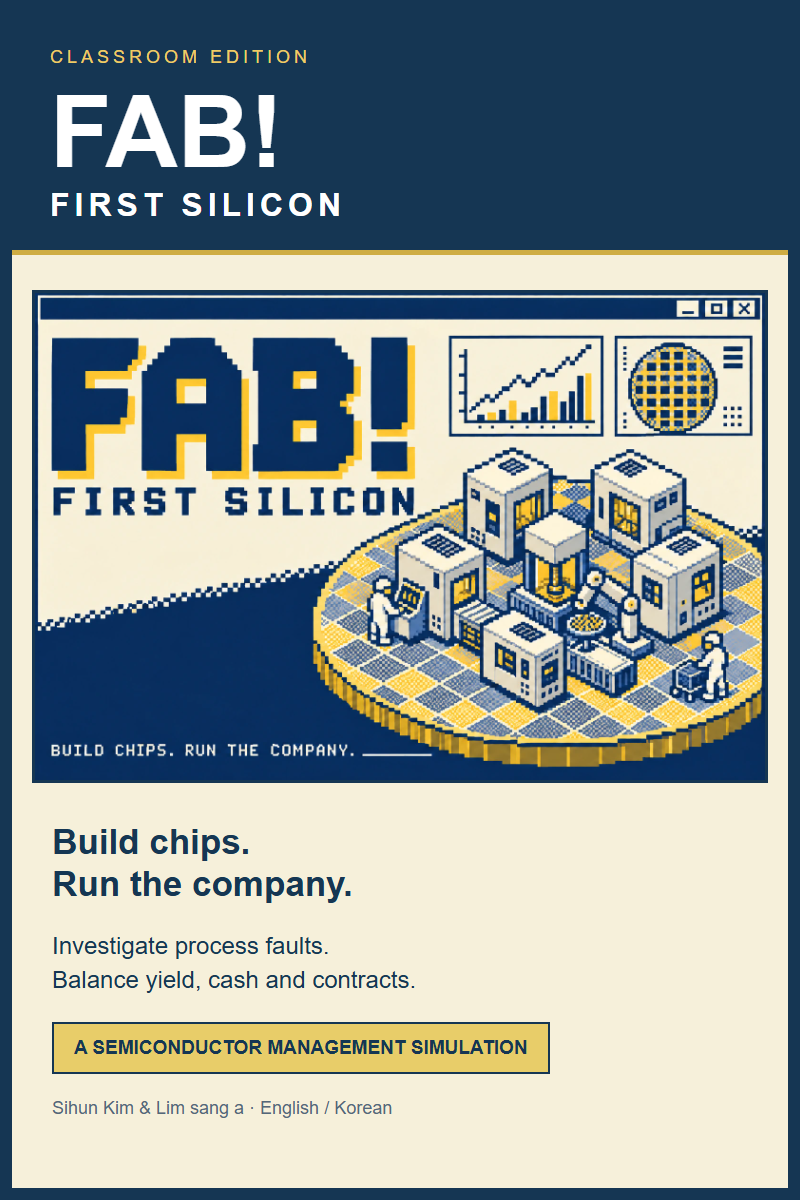
FAB! — First Silicon
$4.99/seat/year
by Sihun Kim
BUILD CHIPS. RUN THE COMPANY.
Take charge of a semiconductor company through a retro operations desktop. Across eight simulated weeks, plan memory production, investigate process faults, develop technology, maintain equipment, read market reports and decide when to sell. From W3, optional foundry contracts add customer specifications and delivery deadlines.
The line runs automatically. Your job is to make the important decisions: protect current output or spend time testing a process change; sell inventory for cash or reserve it for a commitment; invest now or preserve financial headroom. Follow the result through good output, unit cost, cash flow and the final company report.
CLASSROOM USE
Designed as an introductory decision-making activity for upper-secondary and tertiary learners (suggested age 15+). No prior semiconductor course is required, but teacher scaffolding and basic percentages help. English and Korean, selected interactive practice modules, an illustrated semiconductor starter guide, adjustable text size, audio controls and reduced character motion are included. A desktop or Chromebook-size display is recommended.
A suggested 50-minute introduction focuses on a few decisions; a two-lesson sequence allows a fuller campaign and debrief. These timings are planning estimates, not measured classroom results. Teacher-only guides provide lesson plans, misconceptions, worked cases, a rubric and answer notes. Public student workbooks support prediction, calculation and reflection.
LEARNING RECORDS AND SAVING
The education build uses the identity supplied by the edu.games launch, with no separate game account. It records session starts, attempts, decisions, weekly outcomes and completion when a valid platform launch is provided. The business-target pass/fail is an operational game result, not a validated knowledge or mastery score. Custom teacher charts depend on platform support and observed records.
Browser storage may be temporary inside the classroom player. A manual session-code copy/restore flow is included for continuing between lessons; automatic cross-device resume is not promised. The optional scenario code aligns starting resources only, not later random prices or events, and is separate from the edu.games class-join code. Do not enter real names or email addresses as company or scenario names.
ABOUT DEVELOPMENT
FAB! was developed in parallel with DRILL!, with final revisions and checks informed by feedback from DRILL! playtesting. Both projects continue to be refined through player feedback. If you would like another example of our industrial management and evidence-based decision-making games, see DRILL! on our studio profile.
This is an Early Access educational simulation. Prices, yields, process indices, sites, timing and contracts are simplified fictional teaching parameters, not professional manufacturing or accounting guidance. Classroom educational effectiveness has not been formally evaluated. If semiconductor manufacturing and management do not interest you, this specialist theme may not suit your interests.
Created by Sihun Kim and Lim sang a. AI tools assisted parts of the code, writing, translation, artwork and audio; the creators directed and reviewed the game design and revisions.
Subjects
EngineeringElectrical & Electronic EngineeringBusinessEconomicsCritical Thinking & Problem Solving+1 more